Modern Offender Management Software vs. Legacy Systems: 5 Key Differences

Updated: Jun 23
In the world of corrections and public safety, the technology you use directly impacts efficiency, security, and outcomes. Many agencies still rely on legacy offender management systems; older, on-premise software that has been in place for years. While familiar, these systems often lack the capabilities of modern solutions.
If your agency is considering an upgrade, it's crucial to understand the fundamental advantages a modern platform like Offender360 can provide. Here are the five key differences between modern offender management software and legacy systems.
1. Centralized Data vs. Information Silos in Modern Offender Management Software
Legacy Systems: Older systems are often fragmented. Information about an inmate's history, case plan, and medical records might be stored in separate, disconnected databases. This creates information silos, making it difficult for staff to get a complete, 360-degree view of an individual.
Modern Software: A modern solution provides a single, centralized database. All authorized personnel can access up-to-date information from one platform, eliminating data duplication and ensuring decisions are based on the most current and complete records available.
2. Cloud-Based Accessibility vs. On-Premise Restrictions
Legacy Systems: Traditional software is typically installed on local servers at your facility. This restricts access to on-site terminals, making remote work or field access for community corrections officers nearly impossible. It also means your agency is solely responsible for all IT maintenance, backups, and security.
Modern Software: Cloud-based platforms allow secure access from anywhere with an internet connection. This is a game-changer for pre-trial and community corrections officers in the field. Furthermore, the provider manages server maintenance, security updates, and data backups, reducing the IT burden on your agency.
3. Data-Driven Insights vs. Basic Reporting
Legacy Systems: Reporting capabilities in older systems are often rigid and limited. Pulling custom reports can be a complex task requiring IT intervention, making it difficult to analyze trends or measure program effectiveness.
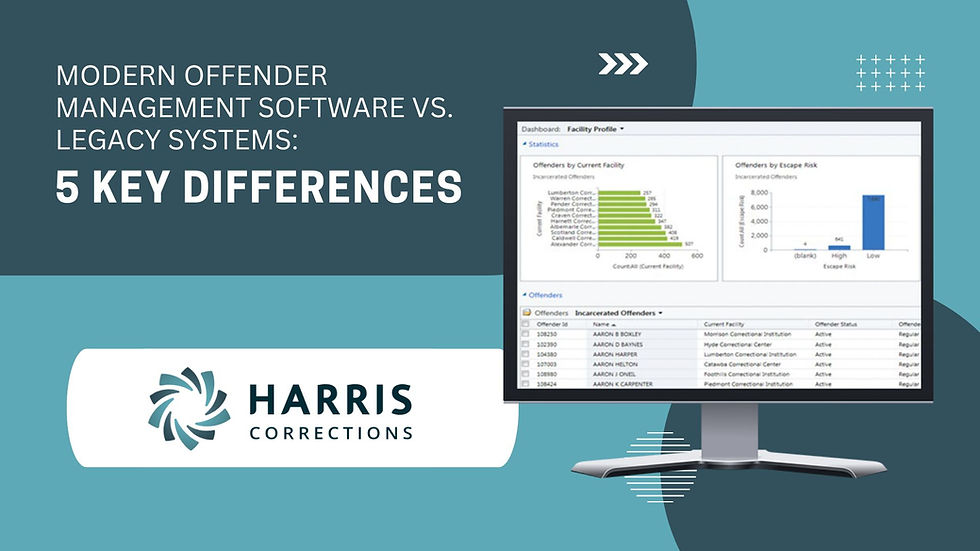
Modern Software: Modern offender management software comes with powerful, user-friendly reporting and analytics tools. Staff can easily generate custom reports, visualize data on dashboards, and identify trends related to population management, program outcomes, and operational efficiency. This empowers agencies to make proactive, data-driven decisions.
4. Integrated Modules vs. Standalone Functions
Legacy Systems: In a legacy environment, functions like jail management, pre-trial services, and community corrections often operate as separate software modules that don't communicate well with each other.
Modern Software: An integrated platform combines all these functions into one ecosystem. Data entered during the pre-trial phase is instantly available to jail management staff and later to community corrections officers. This continuity of data reduces manual entry and ensures a smoother transition for offenders through the justice system.
5. Scalability and Configurability vs. Rigid Structure
Legacy Systems: Older software is often rigid and difficult to adapt. As your agency's needs change or new regulations are introduced, modifying a legacy system can be expensive and time-consuming.
Modern Software: Modern solutions are built to be flexible and scalable. They can be configured to match your agency's specific workflows and can easily adapt to growth or changing requirements. This ensures your technology investment remains valuable for years to come.
Is it time for an upgrade? If your agency is struggling with information silos, limited access, and inefficient reporting, it's time to explore the benefits of a modern offender management solution. Contact Harris Corrections today to learn how Offender360™ can transform your operations.
Comments